Tuesday, 24 August 2010

Landscape & Urbanscape Competition Winners Interviews


The LPA works very hard to promote its members and winning our competitions gives us a chance to give them more good PR. Here are the interviews we held with the winning twelve photographers.

Landscape Single Image Winners

Geoffrey Howe - Gold Interview
Jayne Dennis - silver Interview
Glenn Harper - Bronze Interview

Landscape Series Image Winners

Paul Gorman - Gold Interview
Craig Easton - Silver Interview
Peter Adams - Bronze Interview

Urbanscape Single Image Winners

Nick Alcock - Gold Interview
Drora Bashan - Silver Interview
David Bowman - Bronze Interview

Urbanscape Series Image Winners

Nick Kind - Gold Interview
Ross Andersson - Silver Interview
Burkhard Schittny - Bronze Interview

View the full galleries here,

Landscape single and series

Urbanscape single and series

Ecohealth 2010 Landscape & Urbanscape Exhibition.

An exhibition from the collection of the winners and commended photographers was shown at Ecohealth 2010 through out their three day conference in London. The images were projected in four separate areas around the public spaces and the lecture theatre. Here is the LPA press release that accompanied the exhibition.

The London Photographic Association (LPA), a membership organisation promoting the work and interests of international photographers, photography students and lens-based artists, will be providing a thought-provoking exhibition at Ecohealth 2010. The exhibition will consist of images selected from the LPA's 2010 "Landscape" and "Urbanscape" competitions. LPA Managing Director, Kevin O'Connor, comments on the Association's involvement with Ecohealth 2010.

"The LPA is very pleased to be involved with the Ecohealth 2010 conference and applauds its goals of biodiversity and sustainability," he says. "We live on the most unbelievably beautiful planet and and all need to play our part in looking after it so we can hand it on to future generations. Photographers are a group of people who examine natural beauty, decay and destruction in minute detail and focus on new ways of looking at everyday things.

"It is therefore our hope that the exhibition of images from the LPA's "Landscape" and "Urbanscape" competitions will act as a vivid reminder of the natural beauty of our planet and illustrate man's intervention."

Photograph shown by Glen Harper

Upcoming LPA Photography Exhibition

Artist Sue Golden has curated a photographic art exhibition for LPA/Gallery 1839 opening in Soho, London early October. In this exhibition, called Strange Bedfellows, the tapestry of life is exposed with all its complexities. Here the everyday contrasts with the enigmatic and exceptional, the obvious with the unusual. What’s particular in this presentation is the questions the image groupings provoke - what does a beguiling hybrid feline Tokyo Sphinx cat have to do with a Korean man dressed as a female British noblewoman? Perhaps a commonality of isolated lives…

Strange Bedfellows is a contemporary, eclectic mix of international photographers’ images. Golden has utilised her work experience, artistic perception and a ‘catholic’ eye in choosing a diverse range of images and combinations. Extensive research was undertaken from the sites resulting in a striking conceptual show that relates to the highs and lows of modern times: the contrasts and disparities, the illusions and realities, the unconventional and the ordinary.

All the photographs have been chosen from the fine art, commercial, established and up-and-coming photographers’ collections at the London Photographic Association and Gallery 1839.

Images shown - Existing In Costume Chan-Hyo Bae and Tokyo Sphinx Alissa Eberle

Strange Bedfellows is in 2 parts taking the exhibition/s through to mid November.

This will coincide with the London Art Fairs and East London’s Photomonth Festival.

We will be posting more images from the Strange Bedfellows exhibition over the next month.

Strange Bedfellows 1 & 2 running consecutively at:
The Assembly Rooms
8 Silver Place, Soho, London W1F 0JU
6-22 October and 27 October-19 November 2010

Sunday, 22 August 2010

Nick Alcock Wins LPA Urbanscape Gold Award

LPA Urbanscape Single Image Winner

Nick Alcock had been working on his ‘World' series for some time (and had already entered a completely different kind of image in our Landscape competition, which was commended). "I suddenly realised this 'World' picture fitted the category of Urbanscape perfectly," he says. " You can’t get more of an urban landscape than an image of London, after all. So, I decided to enter it."

The winning image from our Urbanscape single entry competition was taken from the Royal Observatory at Greenwich. "My daughter has recently moved to the town," explains Nick, "and I've become fascinated with the visual vibrancy of the area. The viewpoint I shot from provides a really iconic image of London. You can see everything from the Dome, Canary Wharf and the new Olympic Stadium right across to, and beyond, the Gherkin building."

Nick starts his ‘World’ images by shooting a big panorama (this one was a 12 part stitch). He feels it's important to get this technically and visually as good as possibly. "It’s impossible to make a satisfactory ‘World’ picture without having a sound image to work from," he says. He then spends vast amounts of time in Photoshop producing the final image. "There are literally dozens of visual decisions to make," he says. "There are things you have to leave and come back to the next day with a fresh eye. Sometimes nothing fits and I have to cheat, but my cheats have to remain invisible. It can be quite draining and stressful and sometimes I wonder why I’ve chosen to put myself through the whole process. That’s when I know I need to walk away!

"I’m always surprised how many times a solution comes to me when I’m away from the screen thinking of something else. I also rely heavily on my wonderful A2 Epson printer. I usually print up to 20 tests before I’m happy with the final image."

Nick feels that what makes his winning image so strong is that it's the unfamiliar familiar. "I think it’s the kind of image that’s hard to ignore on many levels," he says. "The amount of detail, the odd glimpse of the river, the on-going building works and, of course, the ‘World’ treatment which gives a new slant on a familiar view."

Nick studied Graphic Design at Camberwell College of Art where photography was an integral part of the course. He particularly enjoyed the darkroom and processing work. "When Photoshop and digital photography came along, it was like all my dreams had come true," he says. He then worked as an art director at major London Advertising agencies, working with some of the world’s top photographers and retouching studios. "I learnt a tremendous amount from them," he says, "particularly how important it is to really look very hard at things. Nowadays, instead of briefing a retouching studio to produce a hugely expensive 10 part comp, I can do it myself. Thank you, Photoshop."

Nick has now been totally freelance for over 20 years, working on everything from TV commercials to book and web design. Since leaving art school, he has always been involved in his own projects and, in recent years, photography has taken a major role in his creative life. He was recently commissioned to shoot a ‘World’ picture for a country house estate in Sussex. He is keen to shoot more images for his ‘World’ series and says there could be some exciting developments ahead.

"I’ve spent my entire career as a creative," he says. "It can be the most rewarding way to earn a living, but also one of the most stressful. When it all gets a bit much I remember, and gain strength from, the famous Woody Allen quote: 80% of success is showing up."
Nick Alcock LPA Portfolio and Profile Page

Drora Bashan Wins LPA Urbanscape Silver Award

LPA Urbanscape Single Image Winner

Drora Bashan started embracing photography after 30 years in the jewellery business. Since 2006, she has been studying photography and participating in Masterclass workshops in Israel.

The image which won Silver in the single entry category of our Urbanscape competition was already in her portfolio, taken in Tel Aviv in 2008. "I took the shot after it had been raining," Drora says. "The sun came out, highlighting the puddles which remained in the middle of the street, displaying a typical reflection of the "White City" of Tel Aviv in golden hues."

This image has seen a lot of success: it was awarded First Prize in the Contrast Category in the "Pixrael – Tel Aviv 100" competition and open-air exhibition (Hungary, 2009) and has been part of a travelling exhibition in China since December 2009.

"I think the sequence of the separate puddles, and the gold reflections contrasting with the street stones, makes it a strong image," says Drora. "The merging of the street with the upside down houses is a 'reality' created by different worlds being momentarily united."

Drora enjoys taking part in competitions. "As an enthusiastic amateur photographer, I really appreciate the feed-back," she says. "I enjoy exploring the themes, investigating my own work and looking at many wonderful photos by other photographers."

Drora's favourite subject is reflections. " My other passion is for details and looking at things from a close perspective, cropping them so they become unrecognisable," she says.

Drora Bashan LPA Portfolio and Profile Page

David Bowman Wins LPA Urbanscape Bronze Award

LPA Urbanscape Single Image Winner

David Bowman took his bronze-winning single image in Houston towards the end of 2009. "I'm not really a city person," he says. "Born and raised in rural Wales, I find them to be chaotic and oppressive. I was wandering around Houston looking for interesting subjects and wanted to find a way to convey my feelings about the place. I looked up at the skyscrapers towering around me. Rather than go for the usual receding towers shot, I decided to whip out my ND3 filter which allowed me to drag the shutter for 5 seconds. For four of those seconds, I kept the camera static. In the final second, I shook the camera which added some motion to the picture. I think that motion conveys a sense of chaos."

David trained in photography and audio visual communication and worked as a freelance photographer in the 1980s. He was an early adopter of digital in the late 1990s and began to focus heavily on fine art, travel and portraiture a few years ago. His current goal is to develop his portrait portfolio, enter a number of competitions and explore exhibition opportunities to explore, as well as add to his fine-art portfolio through traveling.

"I love to hear from photographers and those with an avid interest in photography and welcome anyone who wants to join me on Facebook at http://www.facebook.com/DaveBowmanPhotography," he says.

David Bowman LPA Portfolio and Profile Page

Geoffrey Howe Wins LPA Landscape Gold Award

LPA Landscape Single Image Winner

Geoffrey Howe's winning image in our Landscape single entry competition was taken during a trip to Morocco in 2009. "We were on a mountain pass in the South on our way to the desert region where I was to take a set of images of the 'Groupe des Bambaras', a Berber traditional music and dance group," says Geoffrey. "I like the strong abstract nature of the image, and the depth created by the winding road that leads your eye down to the building at the bottom. It's one of my favourites from the series, and seemed to fulfil the brief of the competition."

Geoffrey's main area of work is dance photography and portrait work. He works with The Sole dance company on their performances at London's The Place theatre. He originally trained in art and design and was involved in furniture and interior design before moving into photography, abstract sculpture and painting.

"I have a strong connection with Vitsoe who manufacture the 606 furniture system designed by Dieter Rams in 1960," he says. "I went to Germany to photograph Dietrich Lub, who was one of the early designers of Braun products in the 1960s and 70s. I photograph many of the Vitsoe systems installed in homes and workplaces, mostly in London but also in Tokyo, Paris and Palma."

Geoffrey likes showing movement in his photographs and is currently working on some abstract portrait shots that include movement.

Geoffrey Howe LPA Portfolio and Profile Page

Jayne Dennis Wins LPA Landscape Silver Award

LPA Landscape Single Image Winner

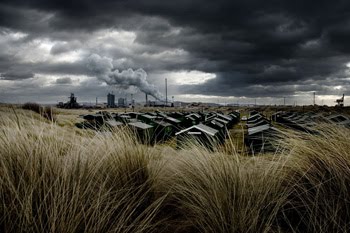
Jayne Dennis shot her Silver award-winning single image at South Gare in Teesside. "The photograph soon became a historical reminder of what once was," she says, "when Corus Steelworks was forced to partially mothball its Teesside Cast Products plant, changing the lives of many local people. In the foreground of the image, we can see the historical fishermans' huts (most of which are still in use today), with the steelworks in the background.

"I’ve always had great interest in human impact on the environment. Although this image is fundamentally industrial, and has environmental connotations, the image still has a beauty about it. Emotional skies such as these feature a lot in my work, and capturing them is a real pleasure. The wild, dark mood emanating from a stormy sky often injects the perfect emotion into my photographs."

Jayne graduated this year with a Degree in Commercial Photography (with distinction) and is now pursuing photography in a professional capacity. She is also a Motion Graphic Designer and Art Director, with a career spanning over a decade designing, art directing and producing 2D and 3D animations and title sequences for television.

Jayne welcomes commissions particularly in the areas of portraiture, editorial and travel documentary. She is planning a trip to Far North Queensland Australia and traveling South to New Zealand at the end of 2010 and has several ideas for documentary projects which she plans to shoot along the way.

Jayne Dennis LPA Portfolio and Profile Page

Glenn Harper Wins LPA Landscape Bronze

LPA Landscape Single Image Winner

Glenn Harper shot the image which won Bronze in our Landscape Single entry competition during a trip south from Lochinver towards the Summer Isles. "I was driving on the 'wee mad road'," he says, "before taking the track up to the Fiddler. It is a suspense-filled walk, as each ridge reveals yet another until, after a few hours, you are rewarded with this magnificent view.

"I like big views, the sense of space. Your eye wanders across the scene, picking out the details and exploring. I enjoy making images where the viewer is invited to do the same."

Glenn's process consists of gathering the frames as the light plays over different parts of the scene. By blending several frames together, he condenses the experience of the environment in to a single image. "I think the landscape itself is foremost in this image," he says. "Compositionally, it is underpinned by strong diagonals which lead you in, coupled with strong contrast balanced throughout the frame creating a high level of detail in the far distance as well as the foreground."

Glenn works as a commercial photographer and enjoys shooting images for his own enjoyment through his personal work.

Geoffrey Howe LPA Portfolio and Profile

Saturday, 21 August 2010

Nick Kind Wins LPA Urbanscape Gold Award

LPA Urbanscape Series Gold Winner

Nick Kind took his Gold winning series of pictures as part of a project for a magazine in Melbourne, where he is based. "The idea was around contrasting landscapes," he says, "and it was my job to make the centre spread to represent the theme. This collection - titled 'Contrast and Reflection' - explores the transformative nature of rain."

Nick explains how living in Melbourne has changed his relationship with wet weather. "Watching Melbourne's continual progression into drought, rain has become something I look forward to, and something which has a fascinating playfulness in the way it transforms the city," he says. "All of a sudden, familiar surfaces are enlivened with a new personality, the water adding a sheen or creating a puddle and capturing reflections. These images present the viewer with something to work out. Many people have asked me what filters or textures I've used. They're always surprised to hear they were simply looking at a reflection."

Nick is a self-taught photographer who works as a graphic designer as well as a freelance photographer. After his first exhibition, he was appointed to teach a night course in Photography at the Richard Attenborough Arts Centre in the UK. "Teaching was a fantastic experience as it accelerated my own learning and appreciation of the art of photography," he says.

Encountering a recent patch of artist's block resulted in Nick's most recent exhibition 'Interference'. The images were well received at a prominent Melbourne gallery earlier this year. "This very personal and challenging show really taught me that it is possible to reconnect with something that you thought had been lost," he says. Nick now aims to secure a solo show to exhibit the 'Contrast and Reflection' collection of images and is working on a project to publish a coffee-table book of his recent collection 'Urban Trace'.

Nick Kind LPA Portfolio and Profile page.

Ross Andersson Wins LPA Urbanscape Silver Award

LPA Urbanscape Series Silver Winner

Ross Andersson began his career as a fine artist, studying painting, filmmaking and photography before discovering a passion for fashion photography. He's been creating intense and iconic imagery for the fashion and beauty industry's advertising scene since 2006. His commercial clients include Macy's, Aveda, Regis, Mia and Maxx and L'Anza Hair Care.

The images which won him Silver in our Urbanscape series entry competition - the mezzanine project - are a new and evolving series exploring the aesthetic abstraction and ideology of modernist public spaces. "The project is a study of line and perspective," he says, "where social intent is purposely concealed. Stark, structural landscapes of concrete and rebar create new narratives that belie function and revel strictly in form, leaving the viewer to invent their own understanding of the meaning and purpose of these strange and compelling landscapes."

Ross enjoys entering competitions, feeling they give him a great opportunity to place his work in front of a different type of audience to his normally strictly-commercial clientele.

He recalls one of his most memorable commercial commissions. "It was a photo story for a hair care client," he says. "The wardrobe was created by gluing together hundreds of paper doilies from the supermarket. It was really outrageous and a lot of work, but the end product was stunning. It won the Grand Prize at the North American Hairstyling Awards show."

Ross is currently finishing Phase Two of his mezzanine project and plans to travel to south America to shoot Phase Three. He'd like to exhibit this Silver winning series and eventually publish a book of the entire collection.

Ross Andersson LPA Portfolio and Profile.

Burkhard Schittny Wins LPA Urbanscape Bronze Award

LPA Urbanscape Series Bronze Winner

Burkhard Schittny has worked on personal photography projects throughout his career, even whilst focused on working as commercial photographer for advertising and magazines between 1997 and 2007. In 2007, he decided to concentrate fully on fine art.

In the winter of 2007, Burkhard travelled to New York City. "When I started filming I didn't have a real concept in mind," he says. "I just wanted to do something. Later, after selecting the stills and working on them on the computer, I realised most of them had a gloomy, murky touch. The series, now called UNTITLED, somehow came back to ideas and feelings I had when I was creating the video performances for my MA at Central St Martins: desperation, insecurity, anonymity and alienation. The stills are like scraps of memory struggling to reveal the fear of a place - fragmented and out of focus."

For these projects, Burkhard films on a consumer video camera, selecting the images on a computer. All images are full frame with no composing, just colourshifting and saturation and desaturation in photoshop. "I keep the characteristic interlaced lines that video creates," he says. "Ideally, the work should be viewed in large scale to understand the construction and deconstruction of the subject."

Burkhard is currently working a series of around 20 new images from different places. He received a project grant from a German organisation for his landscape series and will use the funds to shoot a project about trauma and his own family history in Poland. He hopes to exhibit his UNTITLED series in the near future.

Burkhard Schittny LPA Portfolio and Profile

Paul Gorman Wins LPA Landscape Competition

LPA Landscape Series Gold Winner

Paul Gorman's University tutor encouraged him to enter these winning images - created for a University project - into competitions. "He said my images would win, but I didn't take him seriously," he says. "But lots of people seem to like them and I am very proud I have created them." Paul is currently studying BA Honours in photography at AUCB in Bournemouth

The images were all taken at sunrise or sunset. "The light is amazing at that time and is best suited for landscape," says Paul. "The images are about how we interact with the surroundings and how we direct our vision to objects within the landscape. I wanted to create something that shows how our perceptions can change as we move around, and - through multiple exposures - show how these new perceptions merge with existing ones. I wanted to make the viewer engage with the work in a similar way to how we get a feeling of the sublime when we are in the landscape."

Paul was inspired by Picasso's attempts to show the flatness of the canvas by using lots of different viewpoints on the same images. "I thought it would be great to circle the tree or ponds and take a picture at various points around it," he says. "The backdrop builds up, creating a weird and wonderful world, almost like a dream scene that baffles and challenges the viewer. The more you look, the more you notice." The images were all taken with film.

After graduation, Paul hopes to travel in order to study the theme of human vision.

Craig Easton Wins LPA Landscape Silver

LPA Landscape Series Silver Winner

Craig Easton selected the images which won Silver in our Landscape Series entry competition from the beginnings of a new project which follows on from the success of his book ’52 Weekends by the Sea’. "For me, landscape photography is not about what it looks like, but what it feels like," he says. "The pictures are about the essence of the British countryside, what makes it so special and so different to other landscapes around the world. Space is often at a premium in the UK and these pictures are not just about the landscape itself, but about our influence on it, how we have shaped it and how we live or have lived within it."

Craig's career began in the early 1990s as a photojournalist at The Independent, shooting black and white film and making wet prints in the basement darkroom. Since then, he has shot a lot of commercial and advertising work, alongside books and magazine editorial. Landscape has always been a big part of his work. He recently shot a campaign of sportspeople in iconic British locations. "Whilst these were portraits, they required a really strong sense of the landscape, connecting the British landscape with the 2012 Olympics," he says.

Craig's book ‘52 Weekends by the Sea’ has been shortlisted as a top 5 finalist in the British Book Awards. The associated website www.52hq.co.uk is the beginning of an exciting online community celebrating the British coast.

Craig Easton LPA folio and Profile.

Peter Adams Wins LPA Landscape Bronze

LPA Landscape Series Bronze Winner

Peter Adams's Bronze winning series are aerial photographs taken in Namibia. "This was the first time I've done any aerial pictures," he says. "I was blown away by the new perspective. The pictures here are some of the more abstract from the series; I was particularly enthralled by some salt works. The amazing colours and patterns reminded of the paintings of Mark Rothko."

Peter started his career in 1986, working for design studios, advertising agencies and corporate clients, before concentrating on travel photography. He was awarded Travel Photographer of The Year in 2003. He recalls a commission from his early days as a photographer: "I enjoyed an extended job for a company that made uniforms and work wear. The fire brigade were good enough to set up situations for me. We shot hunting clothes in great light on The Mendips and had great difficulty finding a suitable model for a 18 stone, 5’ 5’’ king of a small African nation! It was all good experience and a steep learning curve."

Peter currently has some limited edition fine art prints coming out through an international gallery. He is working on several ideas for a book (with the possibility of an accompanying exhibition) and hopes to base some of his forthcoming travel plans around these projects.

Peter Adams LPA Portfolio and Profile.

Universal Music Group Clashes with MTV Over Music Videos


Universal Music Group (UMG), the world's biggest record label with hit artists Black Eyed Peas, Lady Gaga and Rihanna, among others, has pulled its music videos from the websites owned by MTV Networks (MTVN).

MTVN, which arguably established the concept of music-TV channels worldwide, including the original MTV, also transmits music videos on the internet. Its most popular websites are MTV.com, CMT.com and VH1.com.

MTVN has always negotiated directly with record companies for its websites' videos. Until last December, when UMG joined forces with another major label Sony Music Entertainment and Abu Dhabi Media Company to launch Vevo, an online streamed music-video syndication service.

UMG is insisting all websites wanting UMG videos must take them from only Vevo. And until its websites comply, MTVN is now allowed to show UMG videos.

In a statement, UMG said it believes it can make more money syndicating its artists' videos through Vevo. It said: "Vevo… is the best way to maximise revenue for our artists, our songwriters and ourselves, while bringing our videos to the widest possible audience."

Negotiations were said to be ongoing and industry observers are also waiting to see if Sony will also want to remove its videos from MTVN sites.

Photography by Agnieszka Zychska

Buying Spree in UK Film and TV Sectors

The season of acquisitions in the UK film and TV industry is here. Hollywood studio Time Warner is now the majority owner of Shed Media, its first investment in a UK independent TV-production company.

According to media reports, the entertainment giant has acquired a 55.75% stake in Shed Media, valuing the latter at £100 million. Shed Media produces international TV franchises Supernanny and Who Do You Think You Are?

All3Media, creator of popular international TV dramas Midsomer Murders and Skins, is reported to be buying Optomen TV. Optomen is another indie production house famous for making culinary shows starring TV chef Gordon Ramsay.

These developments follow the acquisition of UK indie RDF Media by Zodiak Entertainment, a rapidly growing international media group, in June.

Meanwhile, another British institution could be affected by the sale of Hollywood studio Metro-Goldwyn-Mayer (MGM), which is still desperately looking for a buyer to take on its $3.7 billion debt. It's been on sale since April.

Its financial woes could lead to the postponement of the next movie in the James Bond series, which is produced by the Broccoli family-owned EON Productions.

Scheduled to be filmed at the UK's Pinewood Studios, the movie will be directed by Oscar-winner Sam Mendes.

Photography by Agnieszka Zychska

Tuesday, 27 July 2010

LPA Competition's for Landscape and Urbanscape


LPA Competition's for Landscape and Urbanscape are closed for entry
and the judges are making their choices.

The Judges are,

Lucy Bell - Owner / Curator of Lucy Bell Fine Art Photography Gallery & Agency.

Sue Golden - Curator, editor, artist and photographer.

David Edmunds - Curator at Gallery 1839

The winners and finalists will be notified by email by Monday 2nd August.
Interviews with the winners and full galleries will be posted by 23 August.

Photography by:

Marrigje de Maar


Saturday, 12 June 2010

The Art & Craft Of Photographer David Knight


Art and Craft
Of
David Knight

Classically trained in the craft of photography, David Knight is now turning to his artistic side to inspire his advertising work and create a distinctive style.

David Knight has experienced plenty of change in his photographic life. The English-born photographer has worked in both Dubai and Australia.

He was trained in traditional photographic techniques only to then watch digital imaging slowly but surely replace film. And, in his chosen field of advertising photography, budgets have shrunk and a bit of smart software has taken over from time-consuming camera work, set-building and creative problem-solving. At the same time he’s been steadily trying to spend more time on personal projects, an area he confesses to having let slip for too long as he worked hard to get established as an advertising photographer in Australia.

Now, David says, the value of pursuing personal work cannot be underestimated as it helps with the development of a style which, in turn, informs a photographer’s commercial work.

“For a number of years there I had really neglected my own stuff and I was focused just on the advertising work. But I was having withdrawal symptoms so I had to get back to it. My advertising work didn’t really have a set style; it was just whatever the job required so I was a bit of a chameleon there. These days I’m trying to work more on my own stuff and hopefully getting awarded jobs where people are looking at my personal work and wanting to buy into that style. So, I think that, with time, my style will become more and more defined. I find it more rewarding and I feel a lot more invested in my work.”

David also believes that – no pun intended – the wide exposure of personal work is also important so he maintains a Website, but also employs ‘old-school’ promotional strategies such as sending out printed material. He also participates in photography awards, both locally and internationally, most recently making it into Taylor Wessing Photographic Portrait Prize exhibition at the National Portrait Gallery in London.

Vocational Training

Born a bit further up the River Thames at Oxford, the young David Knight wanted to be an artist, but then his mind was rapidly changed by the realisation that at career in fine-art would almost certainly involve teaching, a prospect that filled him with dread.

“One of my friend’s father was my art teacher and I remember, one day sitting, sitting under a tree with this friend – probably smoking –when we saw this man jumping around trying grab branches off another tree.Then my mate suddenly said, ‘Shit, that’s my Dad!’. He was collecting stuff for an art class and, there and then, I decided that that was something I definitely didn’t want to do.

“The thought of teaching absolutely terrified me so I began thinking about what else I could do that would still allow me to be visually creative. Then, at the end of my art course, there was a bit of photography and I think, like many people probably, I was absolutely hooked when I first watched a print developing in the tray. I thought it was magic and I never looked back from there.

“I then went to the Cheltenham & Gloucester College – there were two big vocational colleges in England at the time and it was one of them – and I chose there because it was a very structured course and they were specifically gearing you up to find work, either as an advertising photographer or an editorial photographer. A lot of the degree courses at the time were very arts based and weren’t so focused on teaching you how to use cameras or lighting.

“I was there for a couple of years, then I did the usual freelance assisting thing and then I got a full time job with a couple of photographers. One was Ian Fraser who was an all-round commercial photographer, but he was doing a lot of cars. And the other was Ben Campbell who was more people-focused and he was doing quite edgy fashion stuff. So I got experience in a good mix of things. Both were quite technical and loved the craft of photography which was a very good training.”

This was still in the days of film… “Digital wasn’t around at all at that point”. David was using roll film and 4x5-inch sheet film so he remains a “big camera” person and says that even for his personal work his approach is still “more considered” as learned from many years of using a Sinar view camera.

Chasing The Sun
Like many aspiring young Britons in the mid-1990s, David began to look beyond the shores of his homeland for somewhere he could get established professionally, although he says that his choice of Dubai was mainly influenced by the appeal of a warmer climate.

“England is bloody cold in winter. Basically all my friends had left and gone to other places and I was living in a share house and so one particularly freezing day I thought there’s got to be somewhere warmer. My sister was living in Dubai so I went there for a holiday. I didn’t like it much at first, but back in England, I was encouraged by Ben – who’d grown up in Bahrain – to give it a go so I did.

“Initially I offered to assist, but within six months I was shooting on my own, there was just so much work around. And it was very diverse too. You’d be hanging out of a helicopter one day, the next on a tug in the port and then you’d be working with a creative director from one of the major advertising agencies. You had to wear many hats which made it quite fun. And then, of course, there were the mountains and the desert right on your doorstep with all these fabulous places you could go and explore. And you could still really drive wherever you liked then so it was a great time both personally and professionally.”

David worked in Dubai for nearly four years, before deciding to move on… this time to Australia.

“Again,” he confesses, “the main reason wasn’t really anything to do with career advancement, but if I’d stayed I would have had to find a sponsor and get set up myself which required a big investment in both time and money.

And it was a very transient place so it’s hard to feel settled there and I was really ready to go anyway. Australia was on the top of the list because I’d always wanted to go there.”
Gaining a foothold in a well-established market that’s also quite small and reasonably close-knit must have been something of a challenge.

“Yes, I think it was although, compared to Dubai, Australia seemed like a massive place. In Dubai it was sufficient to go to the pub, chat to a few people and the grapevine would do the rest. At that time, everybody knew everybody. So, when I came here, I decided to get an agent to help get me work and then, a bit later, I dispensed with having an agent and instead had a freelance producer which worked very well for me for a couple of years. But, yes, it was hard initially to break in.”

Commercial Reality
David selected a vocational training course over an arts degree because he wanted to understand the
‘nuts and bolts’ of his chosen profession and to be able to operate a viable business. So he always intended to
be a commercial photographer and advertising work appealed in particular.

“I like having control,” he states simply. “I like to set things up. I like to construct a photograph and with an advertising shoot everybody is on the payroll basically. So there’s a great team spirit where everybody is working towards the same thing. You don’t need to cajole people into doing what you want because everybody is there for one purpose which is great. And while I have been moving more towards the art side, I’m certainly not going to stop doing advertising. Hopefully they’ll compliment each other and keep me inspired for longer… and hopefully they’ll be a crossover of ideas back into advertising.”

He’s become more convinced of the need for a distinctive and definable style as the nature of advertising photography has changed significantly, for both technological and economic reasons.

“There’s been a convergence of things going on. Firstly, we’ve transitioned nearly fully from film to digital, but there were a few years there where things were basically in limbo and it wasn’t really clear where we would go… so you didn’t know where to put your money as far as making big investments in gear was concerned. It was quite a relief when digital imaging got to the point of being, in commercial photography terms, the benchmark.

“Then there’s been a gradual reduction in budgets every year. The eighties and the early nineties were synonymous with massive budgets – almost the champagne era if you like – and I came in at the end of this and pretty much missed the whole thing! But budgets were certainly a lot healthier at the start of my career and they’ve been getting leaner as the years go by. Not that I feel it quite as much because, of course, as you do get older and more experienced you do get some bigger jobs. But I’m sure that 15 years ago we’d have been making three or four times as much money.

“Retouching has added another element in that why would you allow a photographer to absolutely perfect something over two or three days – as a car photographer in a studio would once have done – when two minutes on the computer will fix the problem?

“So, if you don’t bear this in mind, you just won’t get the job in the first place… it’s just a commercial.

Willing Convert

Despite his darkroom ‘revelation’ and training in film based photography, David Knight says he was a fairly willing convert to digital capture once it could deliver enough image quality.

“My first introduction to it was back in Dubai when we had a Phase One salesman come and give us a demo, and that would have been all the way back in 1996. Very early days, and really the only application for it was studio ‘churn and burn’ product photography where the images were only going to end up small.

“So it really wasn’t ready at that point, but I understood the concept of it so I did jump in with some early Canon cameras, although the quality wasn’t there. For me, it finally became viable when Canon brought out the EOS-1Ds Mark II – the 16 megapixels camera – and I bought one of those and first started shooting personal work with it, but then I used it for some commercial jobs and the results were pretty good. But I didn’t become fully committed until I bought a Hasselblad H2 four years ago.”

So, given how much can now be done on a computer – and with more to come with CGI – on balance has digital imaging been a good or a bad thing for advertising photography?

“For a while I was on the fence, but I think that, overall, it’s been fantastic. Ultimately, it’s just another method of recording an image and most of the work is still done in front of the camera with the composition and the lighting, and how you direct if you have talent in the shot. Whether it’s film or it’s digital, if you haven’t done all those other things right, it’s immaterial anyway. And I think everybody forgets, as well, that for quite a while film was scanned and put into the computer and worked on in exactly the same way. But I understand that some people still favour film because it’s obviously got a different look and perhaps it’ll
make a resurgence because of this, particularly on the art side. For me, though, the commercial realities are obvious, starting from just knowing that you’ve got the shot, knowing when to stop shooting and having the client sign it off there and then.”

Creative Control
David contends that having a strong photographic ‘identity’ is important in the advertising world, especially in terms of photographers being able to play a key role in the creative process rather than simply being directed.

“Well, you would hope that a client has already bought into what you do by seeing your work, so perhaps the discussions about creative direction don’t need to be had quite as much. This is definitely where having a more united voice or a clearer style helps… if your work is similar and consistent throughout, the clients come to you for that look.”

Which, presumably, is why self-promotion is so important so your work is seen frequently and so potential clients understand what you’re all about and how you shoot.

“Absolutely, but I neglected this for years. I think I was probably too busy shooting and not really thinking about it, but what I realised, I think, was that if you want to get a certain type of work – and you want to drive your career in a certain direction – then you really have to take the lead and you have to be very clear yourself about what it is that you’re doing so that other people can see that. Hopefully, the work will follow in that direction and, of course, you’ll be a lot happier with your work because you’ve driven it to an area you want to be doing.”

Having weathered the many changes in photography over the last 20 years and still managed to be successful in two very different markets, David Knight says he still has plenty of creative goals that he’d like to achieve. Not surprisingly, one of them is to be able to do more personal work, but still get paid.

“I suppose the very act of supporting yourself by doing what you love is a good thing… and not so many people truly, truly enjoy their work. But my ultimate goal – and it’s probably the goal of most photographers – would be to find a way to still make money only working on your own projects or on those you really wanted to do. And I’d like to have more time to do personal things… like riding around the world on a motorbike.”

Photograph | Finalist, Australian National Portrait Prize, 2007


Edition: April 2010
ProPhoto magazine: www.avhub.com.au
Publisher: Next Media. www.nextmedia.com.au
Editor/Technical Editor: Paul Burrows
Interview and article by Paul Burrows

Monday, 31 May 2010

The Death Of Commercial Photography


The Death Of Commercial Photography

For those of you who follow the LPA you will know that I have been talking about the convergence of stills and moving images for some years now.

Having been around in commercial photography for a while I have witnessed the following 'deaths', or at least 'close calls'.

'death of the glass negative'
'death of black & white'
'death of dye transfer printing & retouching'
'death of the presentation slide'
'death of the pre computer photographic creative industry'
'death of the transparency for reproduction'
'death of E6'
'death of film period'
and arriving next week…. 'death of photography'

The death of commercial photography is a very contentious point and open to lively debate, but this is roughly how the industry has changed over the last forty years.

My point is that things have never stood still in photography. However, the rate at which our practice is now changing (due to the electronics industry) is frighteningly fast and one should be mindful not to get left behind.

We have interviewed two of our long standing LPA members who are working with moving pictures and I hope that photographers reading the interviews will take a positive view of the way forward.

Robert Dowling
Award-winning photographer Robert Dowling has been working in moving images since 1976, producing commercials, documentary and self-generated film. He gives his advice on getting ahead in an
industry on the up……. more

Philip Lee Harvey
Award winning travel photographer Philip Lee Harvey started to produce video four years ago.
"My prediction for the future of the industry is that photographers will be missing out if they don't offer moving images," Philip says."….more

Kevin O'Connor
Director LPA

Photography by Darren Hepburn - Title: Near the edge